Embracing AI in Healthcare - HIMSS26 Europe Insights with Hal Wolf


 RSS Feed
 Challenges and Opportunities in Transforming Healthcare Delivery.
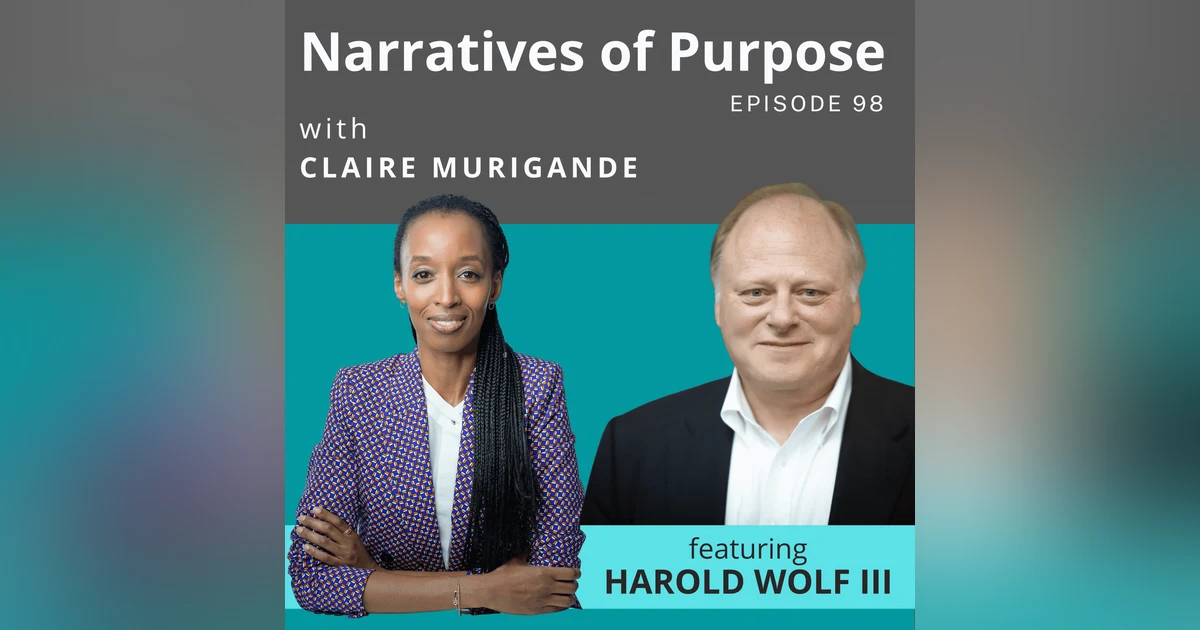
In this first episode of Narratives of Purpose's special series from the 2026 HIMSS European Health Conference, host Claire Murigande reconnects with Hal Wolf, the President and CEO of HIMSS.
HIMSS (Healthcare Information and Management Systems Society) is a non-profit organization with a strong commitment to advancing global health through technology, supporting the transformation of the health ecosystem and fostering health equity.
In this conversation, Hal and Claire talk about the important role of information in modern healthcare technology, addressing workforce shortages through digital health innovations, and learning beyond borders to integrate global perspectives on healthcare.
Be sure to visit our podcast website for the full episode transcript.
LINKS:
- Learn more about HIMSS activities and events at himss.org
- Follow HIMSS on their social media channels: LinkedIn | Facebook | Instagram | YouTube | TikTok
- Follow our host Dr. Claire Murigande: WEBSITE | LINKEDIN
- Follow us: LinkedIn | Instagram
- Connect with us: narrativespodcast@gmail.com | subscribe to our news
- Tell us what you think: write a review
CHAPTERS:
00:19 - Introduction to HIMSS Europe 2026 Special Series
03:00 - The Role of Information in Healthcare Technology
11:11 - Global Perspectives in Healthcare Innovation
15:49 - Challenges and Innovations in Healthcare
21:20 - The Transformation of Health Monitoring through Digital Tools
24:13 - The Role of AI in Healthcare
Mentioned in this episode:
Narratives of Purpose is a proud member of the SwissCast Network
Discover more great podcasts for English-speaking Switzerland
00:00 - Untitled
00:01 - Untitled
00:21 - Introduction to HIMSS Europe 2026 Special Series
03:02 - The Role of Information in Healthcare Technology
11:13 - Global Perspectives in Healthcare Innovation
15:51 - Challenges and Innovations in Healthcare
21:21 - The Transformation of Health Monitoring through Digital Tools
24:14 - The Role of AI in Healthcare
Hello dear listeners, welcome back to Narratives of Purpose, the podcast Amplifying Social Impact. With me, Claire Murigande.I bring you conversations with global change makers who are contributing to make a positive impact in society with a special focus on healthcare innovation. You have just tuned into our first episode of the HIMSS Europe 2026 special series.After last year's success with our HIMSS series, I am back at the Healthcare Information Management and System Society, in short HIMSS, European Conference, this time in Copenhagen, gathering unique insights from some of the conference speakers.But in this first episode, I reconnect with none other than Hal Wolf, the President and CEO of himss, for a follow up conversation from last year's event. By the way, if you haven't listened to our first conversation yet, you should not miss it.Scroll down our episode list and press play on episode number 85. So this time Hal and I talk about the important role of information in modern healthcare technology. We talk about transforming healthcare delivery in the Nordic region, addressing workforce shortages through digital health innovations, and learning beyond borders to integrate global perspectives on healthcare. Enjoy the conversation, share the episode with someone in your network.And remember that you can leave a comment on the Narratives of Purpose website using this short link bit.ly/narrativesofpurpose, then select the Review page.
Claire MurigandeIt's a pleasure to be at HIMSS for the second year.
Hal WolfI know, right?
Claire MurigandeAmazing, huh?
Hal WolfFrom Paris to Copenhagen.
Claire MurigandeExactly. From Paris to Copenhagen. And I have to say thank you for your team for inviting me again to moderate the women's Health session. We had two amazing sessions this morning. Incredible panelists.I'm really fortunate to be in the space with them and I'm really happy that HIMSS is actually offering this space for women's health. We talked about investment a lot. Great insights.
Hal WolfWell, it's critically important and HIMSS has always been a major supporter of women health.It it was one of our first large communities that started and you know, when you look across healthcare as you know the majority of workers in healthcare are in fact women, it's significantly so. So it's not only rationally important, but it's operationally important and it's thought leadership important.And I'm really glad that you took the time to help lead those forums this morning.
Claire MurigandeThank you so much. I just want to as a follow up question, you know last year when you were speaking you presented HIMSS and you mentioned something really important.We didn't really dive into it. It was about healthcare and information and especially information and technology. That actually is not it. It's information and Technology.Can you expand a bit on that?
Hal WolfSure. And this is coming from past cio, me, as we would say, a recovering CIO as the case.It's really important that from a professional standpoint, when we talk about IT information technology, we're really talking about the data center, we're talking about the blinking lights, we're talking about the cable, we're talking about the implementation of software, we're talking about integration. And those are all IT functions, and they're really important. That's the technology. But what are we trying to do?Well, we're not putting in technology for technology's sake. We're putting in technology in order to gain information.And it's the information that we use in our care delivery, in our health, thinking about the individual population, health. It's all about the balance of information. So it was very important that the board.And it was in the first year that I came into himss that we separated it into information and technology because they are two different things. The technology is an enabler to get to the information. We've never saved a life by technology.We've saved a life by the information that technologies bring forward. And yes, we can argue technology helps save a life in the sense of a shock or a wave or something of that nature. And lights help, too.There's a lot of things. Electricity helps, but those are dependencies, those are components.And then we always talk about people, process, and technology because it really takes all three of those things to successfully deploy and get things to work. So that's really that core idea behind that simple change.And I was walking through the lobby here and out front as a cio, an ex CIO of a very large organization in the United States. And when we introduced that, his response when he saw it was, thank you for bringing me out of the dungeon.Because from a technologist standpoint, it really is free because none of us go into it to connect cables. We go into it to produce something better for our patients, our citizens, the clinicians. That's the goal.
Claire MurigandeThe technology is the means, basically, right?
Hal WolfIt is, yeah.
Claire MurigandeTo achieve that. This technology is even more and more important today because we're in the age of AI, right? No one can escape it.
Hal WolfNo, in fact, it's not even a question of escaping. The question is, how do we embrace it?
Claire MurigandeExactly. That's the approach. Right. That's the lens.
Hal WolfThat's the lens. And it's a critical realization that we need digital health capabilities in order to meet the demands of health and healthcare on a global basis.Workforce Shortages, ever increasing amounts of opportunities to look at aggregated data for best case opportunities, recognizing our population health needs, all of these things. And AI helps us in many ways to understand that.It also helps us in our operations, it helps us with supply chain, it helps us understanding our utilization requirements, our demand that's coming up so the predictive modeling that sits behind it. And then finally, and this is an area that gets great levels of scrutiny, as it should, which is the areas around clinical decision support.And when you have clinical decision support, AI is really important to be able to make recommendations. But those final decisions need to be made at the physician level, the clinical level, whomever.But they can bring forward opportunities of new knowledge that no individual alone would be able to go out and find.
Claire MurigandeAnd speaking about, you know, embracing the technology, but also, as you say, this new knowledge and new opportunities. We are here in Denmark, in Copenhagen, Denmark, and from a European standpoint, the Nordics are quite known to be advanced in a lot of things.So what do you think? Denmark in particular, and perhaps even the Nordics to a larger extent are contributing to this advancement of adopting technology in healthcare. And what can other countries in Europe or across the world learn from them?
Hal WolfWhen you look across the Nordics in particular, you have a couple of countries that stand out. So starting from right to left, you know, Finland first of all, has always been one of the top research centers in technology. Nokia's there.And in fact, when I came on my very first trip as CEO of himss, and this was in the first three weeks of my tenure, I jumped on a plane and it went to two countries, one was Finland and one was Israel, because they were the center points and they still lead in many ways of technology advancement. So there are cultures here.And then in Denmark in particular, the efforts have always been at the hospital level, where you have a lot of innovation centers.And in particular Odense University Hospital in Odense, which is in the center of the country, they have been leading in figuring out how to implement and integrate tech into the care delivery in order to expand access and improve quality.In fact, when we started Digital Health Index, which, you know, later became Digital Health Transformation, and we started utilizing a larger scale of measurements, we went there.
Claire MurigandeYeah, I was gonna say it sounds like the himss, the vision of himss.
Claire MurigandeRight, what you're describing,
Hal Wolfand we went straight to Odense University Hospital and said, we want to understand this and let's look at this from a totality standpoint. And they came back and had some interesting observations.And this is when we were transforming MRAM and a number of our maturity models from a technology checklist, which is pretty much what everyone does, to how does it impact access and quality. So when you look at the HIMSS maturity models, that's what makes us really stand out. No one else does that.And so we went to them and we said, hey, this is the new way we're looking at it. Would you test it? They came back and they said, hey, this worked. This, this, this needs adjustment, you know, which is what we do in every single measurement, which is tell us what worked, tell us what we need to improve. That's how we get better and better.But the one thing that they observed, which was fantastic, was they said, you know, in order to accomplish this, we had to get everyone in the room, we had to get the physicians in the room, we. We had to get the nurses in the room. We had to think about the continuity of care, we had to think about how the information flowed up and down.This was no longer just an IT project. So that's what we're after. We're after engagement. And the neat part about HIMSS is that last S which is society, because, you know, bless them.And the founders of himss started back in 1961, they looked up and said, you know what? It's a society. Because no one group in healthcare can make it happen on its own. So a lot of wisdom went into it.
Claire MurigandeSpeaking about countries and regions, I noticed that on the program this year, you have speakers from different places outside of Europe. Top of mind, there's, I think, India, Singapore, Egypt, Kenya.
Hal Wolf100%.
Claire MurigandeAnd you also have one of a session which is probably happening right now or later on this afternoon by the Middle East community.Why is it important to open up to different regions and different countries, areas different from Europe, at a European conference, to have them here and share their input, their experiences. What can European countries benefit from?
Hal WolfWell, look, we live in a global community.If I'm a physician and I'm trying to figure out what's going on with my patient and I go to do a search, I'm not going to say, only show me papers from my area code.
Claire MurigandeFair point.
Hal WolfI don't want to look anywhere else. Why would I. I would never do that.
Claire MurigandeIt's true.
Hal WolfThat would be a breach of ethics. Right? So the same is the true in innovation. Why would I look up and say, I only want to learn what's going on in my own neighborhood?That would either be ignorance or arrogance.It's one of the two we try in every Single conference to cast as wide a net of best practice and best thought leadership possible so we can learn from each other.And by the way, the people who are coming, whether they're coming from Kenya or Singapore or Germany, are going to hear something that's going on in Denmark, going on in Norway, going on in the Netherlands, and they're going to go and take something back. So it's not just I'm bringing my expertise, they're gathering pieces and heading back. And that's how we improve. It's just that simple.
Claire MurigandeIt's coming back to what you were saying, the last S of HIMSS of society. Right. The community is really, you're building this place where the information and experience is flowing, right?
Hal WolfYes, exactly. And how did you get there? What worked? Most importantly, what didn't work and why?Because we really do learn more from our mistakes than we do our successes. Because usually you get two lessons on the mistakes or more. Right?It's the old Thomas Edison thing where it took 2000 tries to get the light bulb and someone said, so you failed 1,999 times. He said, no, I learned 1,999 ways not to make a light bulb. Right. And that's the way you gotta look at it.It's unfair to expect perfection and innovation. We get a little crazy in healthcare sometimes because we don't like making mistakes. We're taught that mistakes cost lives.Well, in certain scenarios that is absolutely 100% true. But when it comes to technology, innovation, we have to rely on each other in order to maximize that space.
Claire MurigandeIt's interesting that you mentioned again the light bulb, because I remember last year when I asked you the question, what is your message for the audience for the keynote and you referred to this slide where you say that, you know, the light bulb didn't come from the continuous improvement of the candle. So it was actually a moment to take a leave. Right. Where do you stand today with this message?What is it that you want people to take away from this conference this year in Copenhagen?
Hal WolfI think there's a very serious message that we need to understand in our healthcare ecosystem. We are facing really critical shortages in workforce. We are facing economic issues across the globe.They were there before some of the tumultuous wars and issues that are going on in the world today that weren't even there a year ago.But nonetheless, the pressure was already building and I think we're headed towards a needed scope of practice change, which is a big phrase in care delivery. So if we go back 15 years ago, maybe 20 depending upon where you were. We went through a scope of practice change.We had a lot of things being performed by physicians that could be performed by nurses and MAs. So we shipped it responsibilities to nurses and MAs so that everyone could basically work at the top of their license.And what that did is it gave us better access to a broader range of people by spreading out who could see whom. And it gave us a lift. It gave us some better access, it gave us some better quality outcomes for sure.But the reality is that the gaps have continued to grow. And so what do we do? Well, we're not producing physicians and nurses fast enough. If you do the math, that isn't going to happen.And it's not about building new hospitals. I can build them all with my magic wand. I have a great one I carry in my bag, but I can't staff them.So I have to go back to what we started talking about in the beginning. Digital health technology, AI assisted devices, et cetera. That is critical. And we need to incorporate them faster and more assertively.We're kind of on a three year clock, okay? We really are. If you just look at the basic economics. We gotta pull this together because we are taking care of more and more people. And why?Two basic reasons. One, our population is getting older, living longer. Wonderful. The longer you live, the higher the likelihood of chronic disease.And secondly, we are so much better at identifying chronic disease today than we were 10 years ago, much less 20.And so we're catching things earlier and we can put people on programs earlier and when we can get them on a program early, that's secondary prevention. Cause we've identified something that's going to happen, an anomaly from norm or has happened. And so we've got to take care of those people.So that's where we are talking about.
Claire MurigandeYou know, staffing hospitals and healthcare professionals. I know that HIMSS is also supporting the community and creating certifications and programs. Can you talk about those programs? What are you offering?I noticed a couple of new things this year.I think it's not necessarily tied to the conference itself, but it feels like you're expanding also to the people attending the conference to get these certifications.
Hal WolfYes. HIMSS has always had a very strong professional development side to it.We usually have two programs starting with CP himss and we work our way up, which is basic technology and then more mid level advanced technology. And that's always been important.We've added in of course the strategic side because developing and understanding the strategy from a technology Back in through the people process and technology piece. Very important. But we've also expanded our relationships on a networking basis with other organizations.PMI is a great example ache other areas where we're working with the best of the best in order to make sure that educational programs are available to people so that they understand how to maximize this investment, maximize the use of information. And also. And this can't be lost, we're going through this change in scope of practice.We're talking about care taking place outside the four walls of a hospital or a clinic, the classic medical model. So now we're going into the health model, whether it's on your phone or your ring device or whatever the case may be, which is now contributing.And when it's contributing to you, you get this really cool opportunity to say, all right, how do I integrate it? When do I integrate it?What's the important moment where the information that's being created out here needs to be in front of my position as an example. So I'll give you a personal example and fully recognizing that, you know, anecdotal is not data, but it's a good. It was a good one for me.I was fortunate enough, still do, to have a prototype of a blood pressure measurement ring.
Claire MurigandeOkay.
Hal WolfIt takes a snapshot of my blood pressure every hour on the hour. I suffer from mild, mild hypertension.My physician was doing exactly what one does and says, you know, come in every two months, come in every six months, whatever. The thing is, we'll take a snapshot, really a bad and inefficient way. So then they say, measure yourself at home.And everyone always says the same thing, I'll measure it every day. But they don't.
Claire MurigandeBut you can't.
Hal WolfAnd you can't. The ring measures it every hour on the hour. And it takes the high of your measurement within the hour, so your worst case.And it puts it within the framework of the parameters you set up. Like, for me, my margin of error is 1:30 over 80. And I want to be in the middle of that space, which is great.So I noticed because of my ring, where my spikes were taking place. And I went to my physician and said, here, look. Said, wow.Never would have known that trend if you didn't have something that was measuring you like this, we would never see it. Let's move. When you take your half dose of your pill, let's move it here. And it planed it right out.And I went in for my physical two weeks ago, and my blood pressure was somewhere like around 113 over 72. It was like right in that ballpark, which he was like, that's great, you know. And I'm like, thanks, I cheated. And he goes, how did you cheat?And I said, well, first of all, we made the adjustment, but I also noticed that my lowest blood pressure of the day is between one and three.
Claire MurigandeThat's when you had the appointment?
Hal WolfYeah, in the afternoon. Did you notice my appointment was at 2pm?
Claire MurigandeI could see that coming.
Hal WolfAnd he goes, yeah. And he goes, interesting. And I go, yeah, and I'm not going to change it next time.
Claire MurigandeThat's an excellent example.
Hal WolfI'm acting as an engaged individual and most people will act engaged if it's as effortless as just putting on a ring or something. Right.And we're finding incredible ways to utilize devices, to be able to monitor people and to be able to really engage with a patient in non intrusive ways that can give us information that if we didn't have that working for us, we'd be missing an opportunity.
Claire MurigandeI like the example you just shared because my last question I wanted to ask you is more general and to ask you about your take on how we as individuals are transforming or evolving with our relationship through digital tools. Right. Whether it's at the personal level, like you just said, but also as a collective.And for me, sometimes I think that as much as I embrace innovation and all the opportunities, obviously there's always like a flip side to the coin and sometimes you don't necessarily address those topics. So there's going to be one session at the end of the conference after tomorrow and Thursday.And I'm fortunate again to moderate, that is about AI and mental health.
Hal WolfOh yeah.
Claire MurigandeAnd how also you can, whether you want it or not, you can be addicted to your phones or your screens.Because even today, I mean, simple example, when I landed in Copenhagen yesterday, I usually go through the airport and ask someone like, oh, where do I get the train? Or whatever. There was nobody, but only signs everywhere and something to scan your phone with to get your ticket.And it's okay, I can do it, I have my phone. But I kind of missed this thing where someone go left and right and then cross the Red Bridge or whatever, you know.And there's also an aspect of looking at when you speak about climate and environment. Let's not forget this is data. This is not appearing from thin air and disappearing again. So what do we do with all this?I know it's a very complex question, but how do you see this evolving basically?
Hal WolfWell, I Think it's a really astute question. We need to recognize that there's a difference between data and information. Data is useless. It's nothing but ones and zeros sitting inside machines.That's the technology part.When we take data in bunches and we start comparing it, we create outcomes, we create information, and then that information we compare and we get to knowledge. And it's from the knowledge that we derive what can be a clinical utility, an application, et cetera.So when you boil it all the way down, you're kind of looking for needles in the haystack. You're looking for a single or a couple of data points that get fed into an application. That's the result of that whole process.And that's what we call the outcome on an app that tells us, oh, go talk to somebody. So there's a sea of data, and it's doubling globally probably every 12 months now. You know, just massive amount of data. So how do you parse it out?Where do you find it? The short answer to all that is we're winging it. Because what's happening is we're looking at the data at large scale.It's giving us information, it's telling us where to point. But then what AI does and what we do as humans and AI does it better, is saying, okay, I learned that, but what about this?And let me try that process, and let me try that. So it's all about taking this massive C and figuring out what the Dixie cup is that you need in order to deliver what you're looking for.So I think that that's going to be the ongoing piece now, before we would have to look at it at an individual human level, study by study, where AI can look at it in a much broader context. And you mentioned earlier that we're looking at it from a population point of view as well. So all of this is happening simultaneously.We're trying to find the anomaly and it's going to come back to it. So let's just be really clear. You know, all healthcare is, is you and I have our definition of norm as human beings.And it's either how we are coming out of the gate and we compare it to population health, and we're trying to anticipate a problem that's occurring or going to occur, and that's defining the anomaly.And when we define an anomaly which is something that is not what it should be, we go back and we say, okay, do we have a defined care pathway already based upon all that research globally? we were talking about earlier, which allows us to say, okay, if I do this, I take this medicine, I prescribe that, I do this exercise, this checkup, the odds are pretty good you're gonna get better. Okay?And we put you on a care pathway, and if we can't define it, we keep testing you until we can, or we get to name a disease after it, you know, whatever the case may be, which we don't ever want to get to, but there it is. So that's all healthcare is, which is why it's so important to pull everyone together like we're doing here at himss. Pulling everyone together from a research standpoint.Using AI to understand the information that's out there and turn it into more knowledgeable information, which influence a clinician to say, you know, that's a great point. Never would have known that. Look at just what happened in Switzerland. I'm gonna try that. And that's where we're going.And that'll help us and that'll give us better information than we had before. But you have to know what you're asking for and when you really take a look.In the end, medicine will come down to a human to human relationship that's never going away. No physician, no clinician, no nurse practitioner should feel threatened in any way, shape or form that their role's going away.What we can do is supplement their amazing education, their amazing capability as a human to human. And when that encounter takes place, it's for the right reasons, at the right time, at the highest level of necessity.And that produces better outcomes. It allows us to have broader access by the combination of human and technology.And this is a question that's being asked because people are like, they're gonna take physicians away. No, that's not the goal and that's not what's gonna happen. But we have to stretch these precious, precious resources on the clinical side.And I think that's the opportunity we have over the next few years, which is to maximize that as quickly as possible.
Claire MurigandeExcellent. So, looking forward to the next himss. It's in Barcelona, a city I know very well.
Hal WolfThat's right. Yeah, we'll be heading there.
Claire MurigandeHopefully we can have a conversation again.
Hal WolfYeah, well, we're looking forward to picking that up.
Claire MurigandeThank you so much for joining me.
Hal WolfYou bet.
Claire MurigandeLearn more about HIMSS and their mission to reform the global health ecosystem through the power of information and technology with community driven change. Visit their website@hiss.org that's H I M S S.org the link is in the show Notes Thanks a lot for tuning in today.Join me again next week for a new episode featuring Dr. Hannah Allen, the chief medical officer at Heidi Health. Until then, take care of yourselves, stay well, and stay inspired.